Cathars, and the Mystery of the Consolamentum
Montségur, History and Legend
The 16 March marks the anniversary of one of the most tragic and symbolic events of medieval Europe: the fall of the Cathar stronghold of Montségur and the mass execution of its believers in 1244.
For many, this date is remembered not only as a massacre but as the final act in the destruction of a spiritual movement that challenged the religious and political powers of its time.
The Cathars faced an impossible choice: renounce their faith or be executed. Over 200 refused and were burned in a massive pyre. Yet over the centuries, legend has transformed the story. Esoteric traditions suggest that those who received the Consolamentum had their souls freed from the material world, and that the fire of Montségur became a symbolic passage—a mystical purification through which their spirits “ascended,” leaving the physical plane behind. In this view, the pyre was not just an execution but a final spiritual initiation, echoing the Cathars’ dualist belief in the triumph of the soul over matter.
This dual lens allows Montségur to be remembered both as a historical tragedy and a symbol of spiritual transcendence—a place where history, faith, and myth converge.
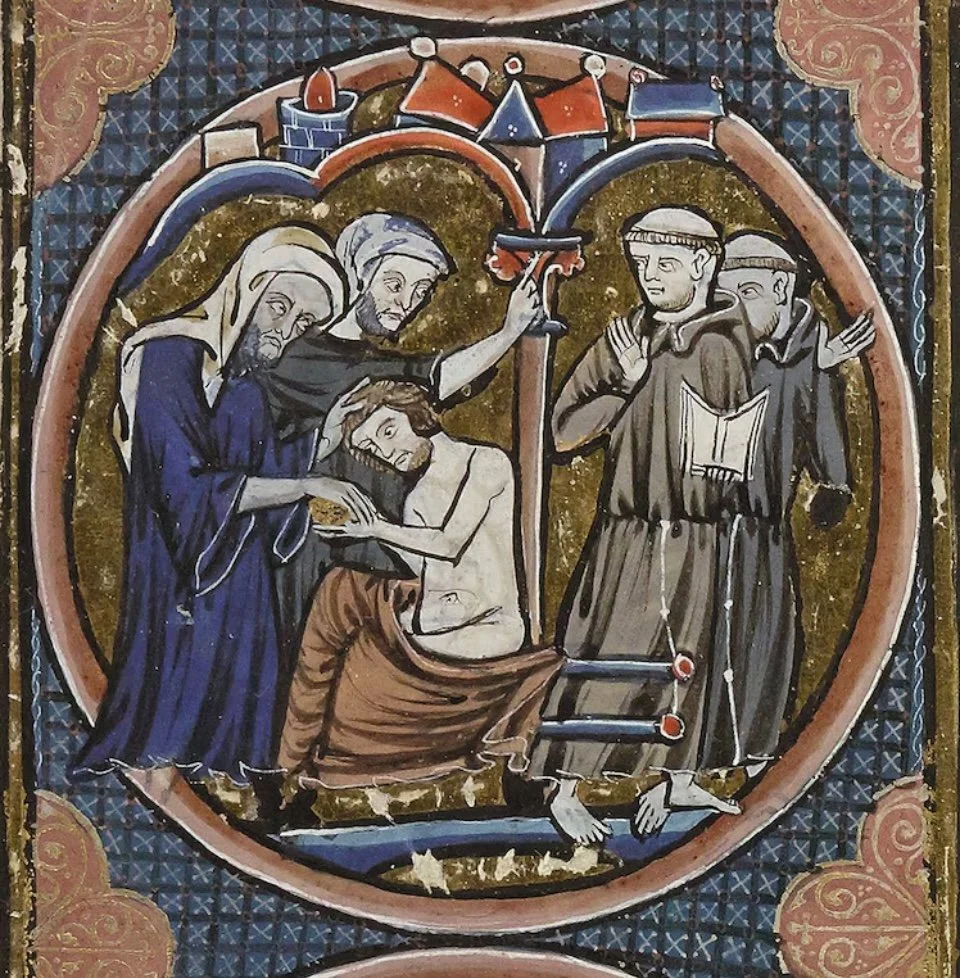
Cathars (left) perform the consolamentum (Cathar baptism) while two Franciscans (right) look on in horror at their heresy. This miniature is from a 13th-century French bible moralisée, an instructional Bible picture book, today in the Bibliothèque Nationale de France, National Library, Paris.
The Cathars and the World They Lived In
The Cathars were a Christian spiritual movement that flourished in southern France during the 12th and 13th centuries, especially in the region of Languedoc.
Their beliefs differed significantly from those of the medieval Catholic Church.
Cathar teachings emphasized a form of spiritual dualism: the spiritual realm, created by a good and pure God, and the material world, which they believed was corrupt or the work of a lesser or evil force. Because of this view, Cathars rejected many established Church doctrines. They denied the authority of priests, rejected most sacraments, and promoted a life of simplicity and spiritual purity.
Their spiritual leaders, known as Parfait or Perfects, lived austere lives of poverty, celibacy, and constant preaching. To many people they represented a moral alternative to the wealth and power of the medieval clergy. This popularity made them deeply threatening to the Church.
“One of the remarkable aspects of Cathar belief was their spiritual egalitarianism”
One of the most remarkable aspects of Cathar belief was their view of spiritual equality between men and women. Unlike the hierarchical and male-dominated Catholic Church of the time, the Cathars taught that the divine spark exists equally in every soul, regardless of gender. Both men and women could receive the Consolamentum, become Perfects, preach, and guide the community. Women often held leadership roles, assisted in rituals, and were fully empowered as spiritual teachers. This radical egalitarianism reflected the Cathars’ dualist worldview, which saw the material body as separate from the soul, allowing both men and women the same potential for spiritual purity and transcendence.
The Albigensian Crusade
In 1209, the Church launched a military campaign against the Cathars known as the Albigensian Crusade. Supported by northern French nobles and encouraged by Pope Innocent III, the crusade aimed to eradicate Catharism completely.
But religion was only part of the story.
The wealthy and culturally distinct south of France had long resisted control from the northern French monarchy. By framing the conflict as a crusade against heresy, the French crown gained justification to conquer these lands and weaken local rulers such as Raymond VI of Toulouse.
The result was a brutal war that devastated the region.
Even after the crusade formally ended, Cathar communities survived in remote mountain fortresses. One of the last and most famous was Montségur.

The fortress of Montségur in the Pyrenees
The Siege of Montségur
In May 1243, royal forces began the Siege of Montségur.
The fortress stood high in the Pyrenees, difficult to reach and easy to defend. For nearly nine months, Cathar believers and their protectors held out against the besieging army.
Finally, in March 1244, the defenders agreed to surrender.
They were given a choice:
renounce their beliefs or face execution. More than two hundred Cathars refused.
On 16 March 1244, they were led down the mountain to a field known as Prat dels Cremats—“the Field of the Burned”—where they were burned alive in a massive pyre.
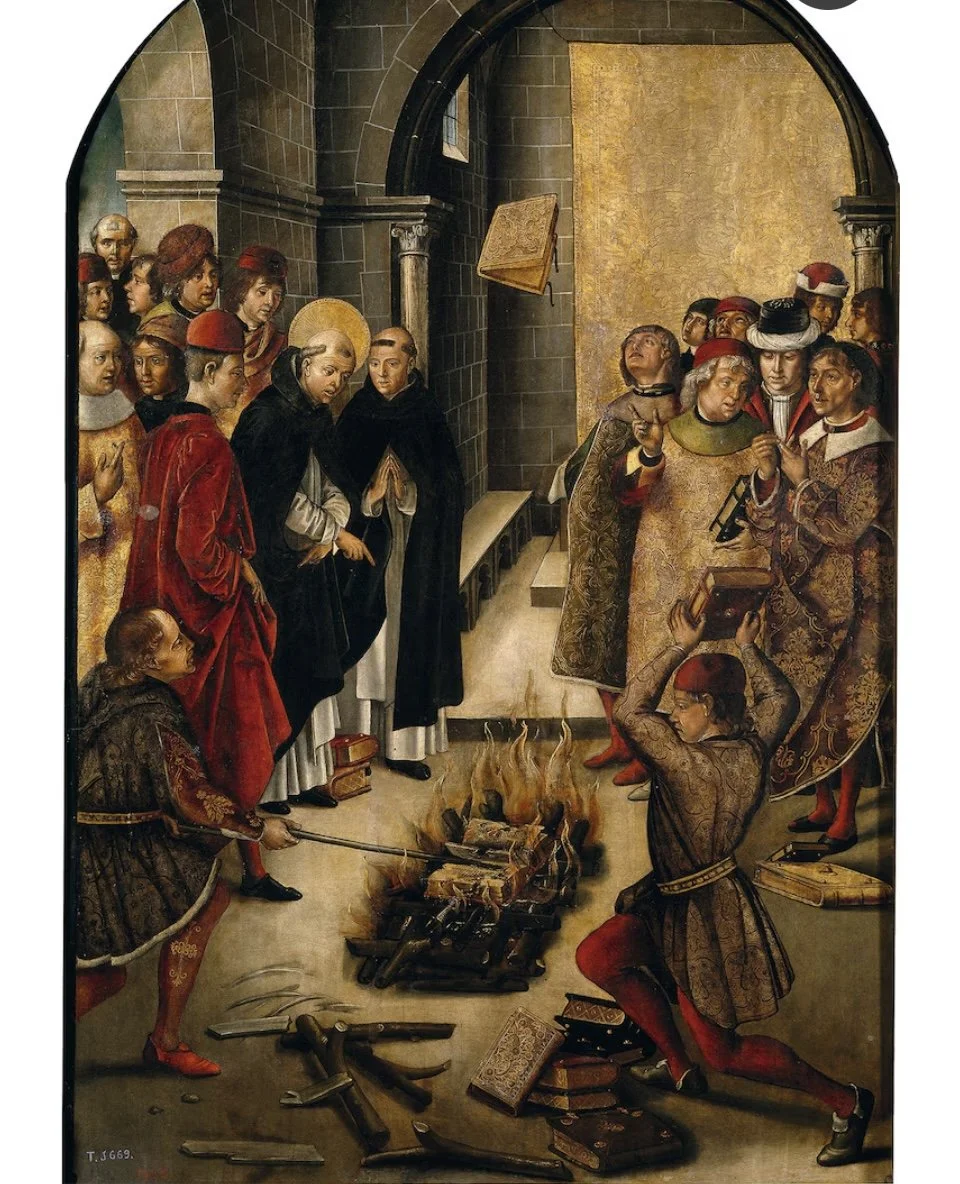
The future Saint Dominic (at left with halo) watches his book rise above the flames, while books of the Cathars burn. This late 15th-century painting is by Pedro Berruguete. Prado Museum, Madrid.
Many Magdalene and the Cathars
According to Gnostic and esoteric traditions, after the crucifixion, Mary Magdalene and the Apostle John survived the Crucifixion and carried Jesus’ teachings to southern France.
The Cathars were said to practice a “Church of Love,” a spiritual tradition that revered the divine feminine and placed Mary Magdalene at its heart. In their view, this sacred path differed greatly from the patriarchal Roman Catholic Church, which they saw as bound to the material world and its corruption.
Mary Magdalene is often portrayed as the guardian of hidden wisdom, preserving the spiritual knowledge of Jesus’ inner circle, while John is depicted as her companion in transmitting these teachings. Legends hold that together they traveled to Provence and Languedoc, laying the symbolic foundations for the spiritual movement that centuries later became associated with the Cathars.
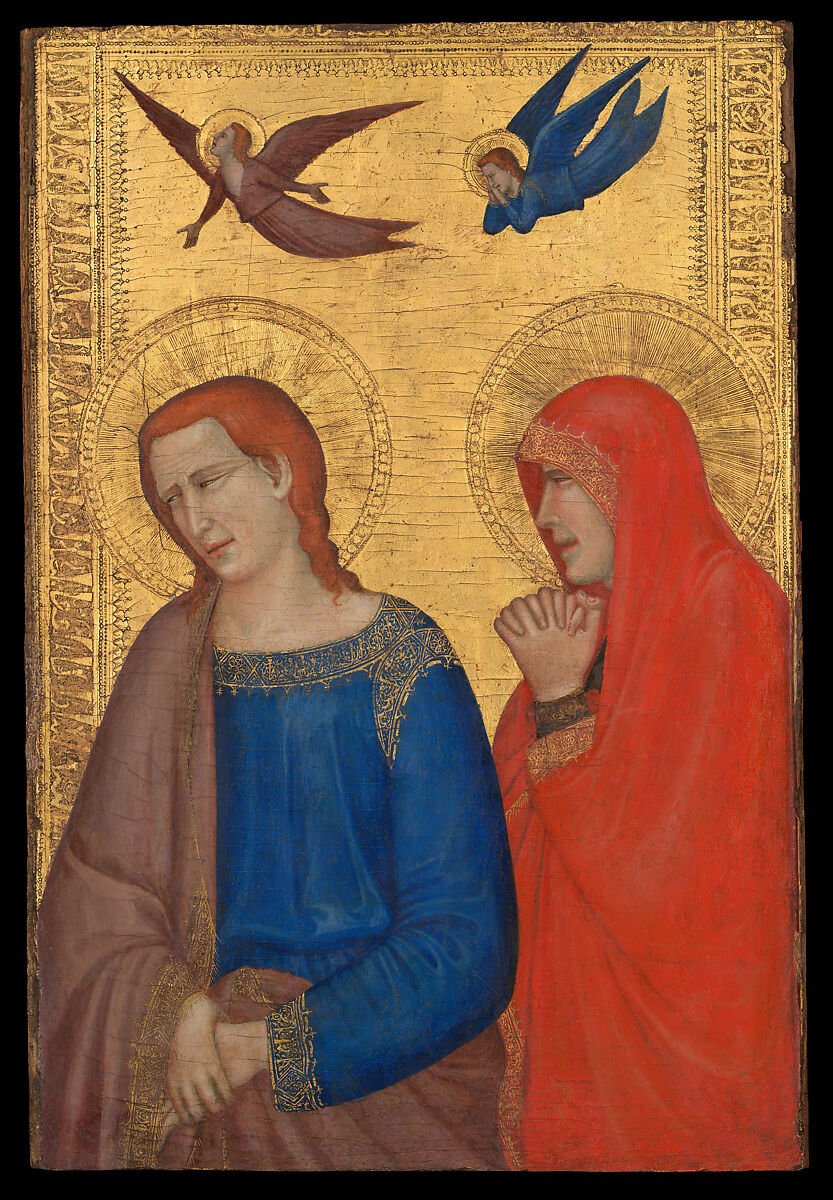
Title: Saints John the Evangelist and Mary Magdalene
Artist: Italian, Neapolitan Follower of Giotto (active second third of the 14th century)
Date: ca. 1335–45. The Robert Lehman Collection
This mystical lineage resonates at Montségur, where the believers embraced the Consolamentum as a ritual of spiritual awakening, embodying the purification and inner enlightenment that Mary Magdalene was believed to have preserved.
While there is no historical evidence that Mary Magdalene or John physically founded the Cathars, these stories endure as a symbolic bridge between early mystical Christianity and the Cathar vision of the soul’s triumph over the material world, emphasizing the transmission of hidden knowledge, spiritual purity, and the awakening of the divine spark across generations.
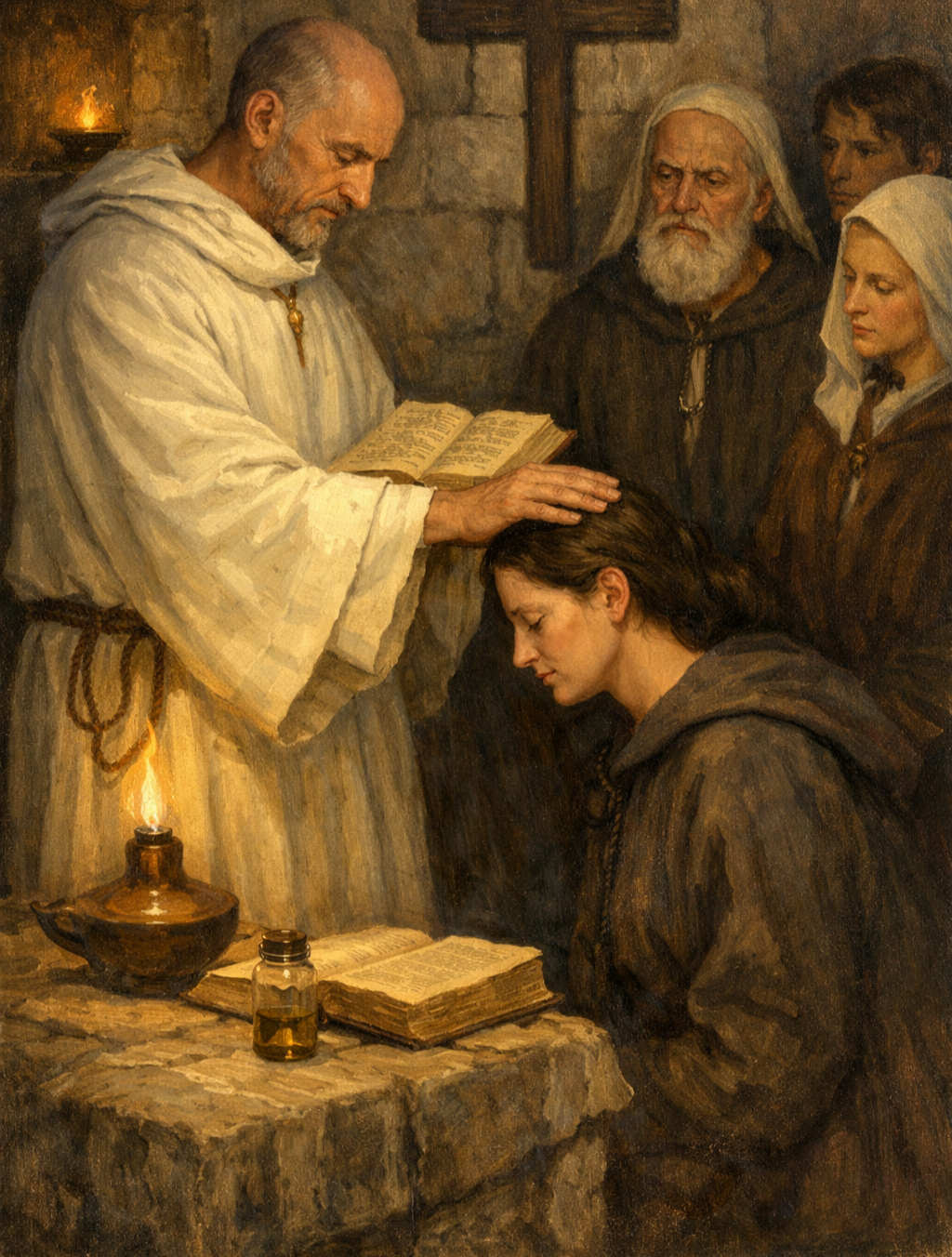
The Consolamentum:
The Cathar Sacrament
The Consolamentum: The Cathar Sacrament
At the heart of Cathar spiritual life was a ritual called the Consolamentum, meaning “consolation” or “spiritual comfort.”
The ritual involved the laying on of hands by a Perfect upon the initiate, while prayers were spoken.
To the Cathars, this act represented: the reception of the Holy Spirit, purification of the soul and liberation from the corrupt material world.
After receiving the Consolamentum, a person became one of the Perfects, committing to a life of strict spiritual discipline. Because these rules were extremely demanding, most Cathar believers waited until they were close to death before receiving the sacrament.
During the final days at Montségur, many believers asked to receive the Consolamentum. By doing so, they fully embraced the faith and knowingly accepted the consequences of refusing to renounce it.
The Esoteric Meaning of the Consolamentum
Beyond the historical descriptions, many scholars and mystics have interpreted the Consolamentum in a deeper, symbolic way.
In esoteric Christianity, the ritual can be seen as a form of spiritual anointing—an awakening of the divine spark within the human soul.
The word Christ itself comes from the Greek Christos, meaning “the anointed one.”
Under this interpretation, the Consolamentum represented not merely a ceremony but a direct transmission of spiritual awakening, allowing the individual to reconnect with their divine origin.
This perspective links Cathar spirituality with earlier Gnostic traditions, which taught that salvation comes through inner knowledge and the awakening of the spirit.
The Consolamentum was the sacred power of the Cathars, a deeply mysterious ritual believed to connect human beings with the highest spiritual realms. Some traditions even suggest its roots lie in the most esoteric levels of the ancient Egyptian mystery schools, later carried to France by Mary Magdalene and John.
During the Consolamentum, a Perfect would lay hands or offer a blessing to the recipient—often someone approaching death or being initiated into the order of the Perfecti. Witnesses, including relatives and friends gathered nearby, were said to experience a remarkable vision: the veil separating the physical body from the spiritual world would seem to fall away, revealing the radiant beauty of the higher spheres. The person receiving the Consolamentum would step into this luminous spiritual realm, and although the vision was fleeting, it left a lasting sense of awe and connection.
This experience was far more than a glimpse of the afterlife. It was an intimate connection with eternal life, a state of being exalted above the Earth and even above the astral planes that lie beyond it. The effect on those present was profound—ordinary daily life seemed suffused with a subtle, radiant bliss, under the influence of the Holy Spirit, sometimes understood as the feminine emanation of the Divine Mother.
Many mystics and scholars, including Colum Hayward in Arthur Conan Doyle’s Book of the Beyond, have compared the Consolamentum to the essence of the Holy Grail: the ultimate spiritual treasure, a peace beyond understanding: “the peace that passeth all understanding” or the “jewel within the lotus.”
For the Cathars, this ritual was the pinnacle of spiritual attainment, offering both enlightenment and a profound experience of divine love.
Sacred Oil and the Symbolism of Spikenard
In ancient times, anointing with mystical aromatic oils was a sacred act found in many spiritual traditions. Early Christian initiation rituals involved sacred oils anointing.
In mystical interpretations, this anointing symbolizes:
the awakening of spiritual consciousness
preparation for transformation
the transmission of divine knowledge
One oil frequently connected with this symbolism is Spikenard, also known as Nard.
In the gospels, a woman anoints Jesus Christ with costly nard oil shortly before his death. This story appears in the Gospel of John, a text particularly revered by the Cathars.
Mary Magdalene herself understood its profound potency when she anointed Yeshua with Spikenard, to aid his transition from this world to the next. She new the profound mystical significance and potency of its vibrational energy for the ascension process. It is said that Spikenard was believed by the Cathars to enable the body to open up to the Holy Spirit by the sacred power of the Consolamentum, to experience a remarkable vision: the veil separating the physical body from the spiritual world would seem to fall away, revealing the radiant beauty of the higher spheres.
Spikenard was one of the most valuable perfumes of the ancient world, imported from the Himalayas and associated with sacred rites and royal consecration.

The spikenard plant, associated with sacred anointing and spiritual awakening.
Mystical Alignments of Montségur
Modern researchers and mystics have noticed that Montségur is not only a fortress but also a spiritual observatory:
The mountain is aligned with the sunrise on the summer solstice.
Some scholars suggest that the Cathars may have used solar alignments to mark sacred times for initiation rituals.
Light and fire, key symbols in Cathar cosmology, may have been intentionally linked to these celestial events.

In this view, the fortress itself becomes a cosmic symbol:
The mountain represents the ascent of the soul from the material world.
The rising sun symbolizes the return of divine light into the human spirit.
The pyre of Montségur, then, is both a literal and symbolic passage: death as a final initiation, echoing the transformative essence of the Consolamentum.
The Legacy of the Cathars
Although Catharism was largely destroyed after Montségur, its story continues to inspire historians, spiritual seekers, and researchers.
Because much of what we know about the Cathars comes from records written by their enemies (which is the case in most history books) their true beliefs and rituals remain partly shrouded in mystery.
Were the Cathars simply a medieval heresy?
Or were they the last guardians of an ancient mystical knowledge, preserving the secrets of light, the divine spark, and cosmic alignment?
Whatever the answer, Montségur and the Consolamentum remain powerful symbols of faith, conviction, and spiritual awakening, reminding us that the search for truth transcends the material world.
Today, Montségur attracts pilgrims, spiritual seekers, and travellers drawn to its mystical heritage:
Meditation Retreats: The mountain’s high vantage and serene surroundings make it ideal for silent contemplation and connecting with the “inner light.”
Sacred Travel: Many modern travelers hike to Montségur to honor the courage of the Cathars and experience the historical resonance of the site.
Mystical Practice: Contemporary esoteric and spiritual groups interpret the Consolamentum symbolically, using it as inspiration for rituals of awakening, initiation, and alignment with the cycles of the sun and nature.
In essence, Montségur continues to serve as a bridge between history, mythology, and personal spiritual transformation.
Bibliography
Sumption, Jonathan. The Albigensian Crusade. Faber & Faber, 1999.
Des Vaux de Cernay, Peter. History of the Albigensian Crusade. Translated edition.
Duvernoy, Jean, ed. The Inquisition in the Middle Ages: Selected Documents. Harper, 1998.
Barber, Malcolm. The Cathars: Dualist Heretics in Languedoc in the High Middle Ages. Longman, 2000.
Moore, R. I. The War on Heresy: Faith and Power in Medieval Europe. Penguin, 2012.
Laborderie, Olivier de. The Cathars and the Albigensian Crusade. Editions du Seuil, 1999.
Markale, Jean. Montségur and the Mystery of the Cathars. Inner Traditions, 2003.
Walker, Barbara. The Woman’s Encyclopedia of Myths and Secrets. HarperSanFrancisco, 1983.
Markale, Jean. The Grail: The Celtic Origins of the Sacred Icon. Inner Traditions, 1998.